Commercial Waste in Richmond upon Thames for organised business collections
Commercial waste in Richmond upon Thames needs a service that is steady, clear and suited to the rhythm of trading premises. We handle routine business waste removal for offices, shops, hospitality venues, clinics and other workplaces that need mixed commercial rubbish taken away without disrupting the day. The focus is on practical collection, sensible sorting and a straightforward route to keeping waste under control, whether the job is a one-off clearance or an ongoing removal arrangement.
Our business waste removal service covers common office and commercial streams, from general refuse and packaging to redundant items that no longer belong on site. Where businesses are reviewing wider disposal needs, the work can also sit alongside our waste removal service for broader mixed loads. The aim is to give you a clean, dependable way to clear away what is building up, while keeping the process simple enough for managers, landlords and operators to plan around their own schedules.
If you need a quotation, send through the details of the waste and the access involved, then ask for a price based on the actual job. If the load includes specialist materials, mention that early so the right handling route can be confirmed. Clear information helps produce a more accurate estimate, especially where items are bulky, stacked in several rooms or mixed with heavier contents. Start with the basics and build from there.
Regular commercial collections for workplaces and shared premises
Many customers need commercial waste collected on a repeating basis because refuse volumes vary through the week and between departments. Office clear-outs, retail stockroom tidies and back-of-house housekeeping all produce items that should not linger. Our service is designed to remove ordinary commercial waste from premises that want a tidy, workable environment without having to coordinate ad hoc disposal every time bins fill or storage corners begin to overflow.
Where the material is largely non-hazardous and suited to standard disposal, collections can be planned to match trading patterns. That may suit offices clearing paper-heavy loads, shops dealing with packaging and display waste, or service businesses disposing of everyday items that are no longer useful. For premises with concentrated rubbish in a single area, a more focused collection can be arranged so the waste is removed efficiently rather than in several small visits.
Useful items to prepare before you request a quotation:
- a simple note of what needs removing;
- an estimate of how much space the waste takes up;
- details of access, lifts, stairs or loading points;
- any separation needed for confidential, recyclable or specialist items;
- your preferred timing if the removal needs to avoid busy periods.
Office waste and confidential clear-outs
Office waste can include paper archives, filing cabinet contents, broken furniture, packaging, monitors and a long list of obsolete items that accumulate around desks and storage rooms. Our office collections are intended for businesses that want to remove those items in an orderly way, especially when they are refreshing workspaces, consolidating rooms or preparing areas for another use. We can deal with a broad mix of office rubbish as long as the load is described clearly at the start.
If records and paperwork are involved, the job should be separated into normal disposal and secure document handling where needed. That keeps the collection organised and avoids uncertainty about what should be treated differently. For items such as desks, chairs, shelving or other office fittings, the service can be combined with our office clearance page when a fuller strip-out is required, or with confidential shredding where sensitive papers need a controlled route.
Two practical points usually make office work easier: first, identify what should remain on site so nothing usable is taken by mistake; second, group the items by room or category if that can be done safely. Those simple steps help reduce time spent sorting on the day. They also make it easier to separate ordinary waste from items that need special care, which is often the difference between a routine collection and a slower, more complicated one.
Furniture, fixtures and bulky items from business premises
Commercial premises often need more than bagged waste removed. Broken furniture, reception seating, cabinets, tables, shelving and mixed fixtures can take up valuable room long after they have stopped serving any purpose. Our removal work covers bulky items that are awkward to move, difficult to dismantle or simply too large to leave waiting in corridors, meeting rooms or storage spaces. The service is suitable where you need the items gone cleanly and the site left easier to use.
For businesses replacing seating or disposing of old tables and storage units, the work may be paired with our furniture disposal page or, where the load is broader and includes different kinds of surplus items, our furniture clearance service. If the items are part of a larger room-by-room clear-out, the same planning can support a wider home clearance or flat clearance style project when the property type calls for it.
Price usually depends on volume, weight, access and the amount of sorting involved. A single set of desks in one room is not the same as a mixed bulk load spread across several floors, so an accurate description matters. Bulky items are often straightforward once the route out of the building is understood. That is why it helps to mention whether lifting, dismantling or waiting time will be part of the job before a quotation is prepared.
Retail, hospitality and trade-related waste streams

Shops, cafés, restaurants, workshops and service businesses often produce waste that is tidy in one sense but awkward in another: packaging, damaged stock, redundant display materials, worn consumables and general refuse can all build up quickly. Our commercial waste service is built for those premises that need removal without turning the back room into a holding area for unsorted items. The work is especially useful where there is a steady flow of mixed waste rather than a single, dramatic clear-out.
For certain premises, the main decision is whether the collection should stay narrowly focused on day-to-day waste or form part of a larger clear-out. If the waste includes old stock, damaged fittings or redundant appliances, it may be practical to combine it with our builders waste clearance when refurbishment debris is present, or with fridge and appliance removal if commercial refrigeration or other electrical units need to be taken away separately. That keeps the disposal route better matched to the items actually on site.
Collections are usually easiest when the waste is grouped before removal, but there is no need to create a perfect pile if access is tight or the room is still in use. It is enough to show which areas contain the unwanted material and which items need to remain. If the load contains sharp edges, awkward packaging or contents from stockrooms, make that clear in your enquiry so the work can be planned with suitable care.
Household-type items handled as part of commercial clearances
Some business premises hold mixed contents that are not purely office waste. Landlords, letting agents, developers and local operators may need a mix of domestic-style and commercial items removed from a property, especially where previous occupants left behind furniture, bric-a-brac, appliances or general rubbish. Our clearance work can be adapted to those mixed loads, provided the contents are described clearly and the scale of the job is understood from the outset.
When the premises are more like a residence than a workplace, our house clearance and garage clearance pages may be more relevant, while a loft or storage area can be dealt with through loft clearance where access and item type call for it. For mixed commercial sites with stored domestic leftovers, this approach can save time because the removal method can be matched to the actual contents rather than to a label alone.
It is sensible to separate anything that may still have value, anything that should stay with the property, and anything that must be disposed of. That simple sorting step often prevents confusion on the day and helps the collection stay efficient. Where the waste is concentrated in one locked or awkward room, mention how access works and whether keys, codes or escort arrangements are required, because those details affect the plan more than the category name on its own.
Pricing, access and the practical details of a quotation
A sensible quotation for commercial waste depends on what is being removed and how straightforward it is to reach. Volume, weight, stairs, lift use, parking constraints and any need to dismantle items can all affect the final figure. The most useful descriptions are usually plain ones: what the waste is, how much there is, where it is located and whether there are any obstacles. That is better than guessing at technical terms or trying to over-describe the job.
If the collection includes specialist waste, such as items with safety considerations or contents that need separate treatment, name them clearly from the start. Our hazardous waste disposal page is relevant where the load falls outside ordinary mixed rubbish, while larger environmental handling questions may connect with recycling and sustainability. For standard commercial rubbish, the aim is simply to understand the load well enough to quote fairly and remove it in the right way.
A useful enquiry usually answers three questions: what needs taking, where it is, and how the team gets to it. If you can also mention any time windows around trading hours or deliveries, so much the better. That is enough to begin. You do not need a polished inventory, but you do need enough detail for a meaningful assessment. If you are not sure whether an item belongs in the collection, include it in the description and ask for guidance.
About Richmond upon Thames
Richmond upon Thames is a borough in southwest London on the north bank of the River Thames, with a stretch of the river also shaping the southern edge around places such as Barnes and Mortlake. The borough was formed in 1965 from the merger of the former municipal boroughs of Richmond, Twickenham and Barnes. It contains a varied collection of districts, from the riverside elegance of Richmond and East Sheen to the more urban centres of Twickenham and Teddington, and the area has long been associated with open space, sporting traditions and historic residences. Richmond Park, created in the seventeenth century, remains one of London’s most distinctive landscapes, with ancient trees, deer and broad views that contrast strongly with the denser built-up parts of the borough. Nearby Kew Gardens, though a separate Royal Botanic Gardens site, forms part of the same wider river corridor and is one of the area’s best-known cultural and scientific landmarks. The Thames towpath, riverside pubs, boathouses and embankments contribute to a strong waterside character, while landmarks such as Marble Hill House, Orleans House Gallery and Strawberry Hill House reflect a long architectural history ranging from Georgian symmetry to the exuberant Gothic revival. The borough’s town centres have their own identities, with market squares, conservation areas, theatres, libraries and local shopping streets giving each settlement a recognisable civic core. Transport links by rail, road and river have also shaped the borough’s growth, helping it remain closely connected to the rest of London while retaining a reputation for relatively spacious streets, parks and historic fabric. That combination of river, parkland, architecture and varied urban centres makes Richmond upon Thames one of the capital’s most characterful areas, with a landscape built as much from green space and heritage as from commerce and housing.
Clearance options for larger or more specialised loads
Some jobs move beyond routine waste and become a broader clearance project. That may happen when a premises is being emptied, renovated, re-let or reorganised, and the contents include a mixture of furniture, packaging, fixtures and leftover items from previous activity. In those cases, the right approach is to group the material by type and decide which parts need a focused service and which can go through general commercial waste removal. Our wider clearance pages exist for those situations where one category alone does not tell the whole story.
For large rooms, storage areas or complete premises, the most relevant pages are often office clearance, garage clearance and loft clearance, depending on the space and the contents. When the job involves a property being emptied of mixed items rather than just refuse, the more general home clearance and house clearance pages may also help define the scope. Choosing the closest match keeps the plan realistic and avoids lumping everything into one vague request.
Where a clearance includes several categories of material, it is worth deciding in advance whether any items should be set aside for reuse, resale, secure handling or separate disposal. That decision is often more important than the room name itself. A clear split between what stays and what goes keeps the collection efficient and reduces the chance of avoidable delays once the work begins.
Common business items we are asked to remove
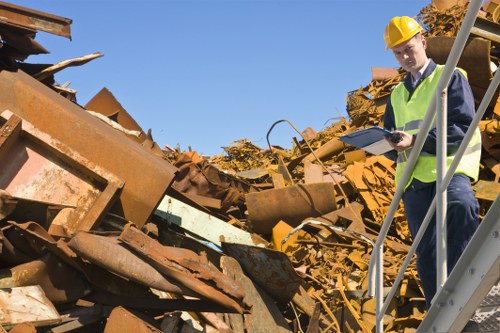
Commercial waste can be made up of many small pieces rather than one obvious pile, so it helps to know what is commonly included. Offices often produce paper, cardboard, filing contents, out-of-date equipment and broken chairs. Shops add packaging, shelving and stock that cannot be sold. Hospitality premises may have tables, seating, kitchen-related waste and mixed refuse. Workshops and trade counters can generate heavier, awkward or dirty materials that still need a tidy removal route.
An organised quotation usually becomes easier when you decide which of the following best describes the load:
- general office rubbish and packaging;
- bulky furniture and fittings;
- mixed contents from storage areas;
- obsolete stock and display materials;
- special items requiring separate disposal.
When you are ready, ask for a quotation and include enough detail for the waste to be identified clearly. If the job is straightforward, a short description may be all that is needed. If it is more involved, mention the key parts in one message rather than sending scattered fragments later. Request a quotation when you have the basics ready, and we can help shape the removal around the actual load rather than a guess.